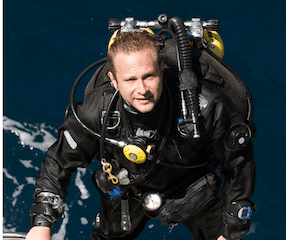
Advanced Recreation Diver
Dry Suit Diver
Practise Q & A which will help you prior to your knowledge reviews
Here are some practice questions and answers to help you along:
Question 1
Explain why even mild hypothermia can be a problem for divers, and how to avoid it.
Question 2
How do you check for proper weighting when diving in your dry suit?
Question 3
Why is it important to not dive with an excessively tight neck seal?
Question 4
How do you attain positive buoyancy at the surface, and maintain neutral buoyancy underwater, and prevent dry suit squeeze when dry suit diving?
Question 5
Describe how to add air to your dry suit while underwater.
Question 6
How do you vent air from your dry suit while underwater?
Question 7
What should you do if you become too buoyant due to excess air in your suit?
Question 8
How can you cope with too much air in your dry suit legs/feet?
Question 9
What should you remember about breathing if caught in a runaway or rapid ascent?
Question 10
List what you should do if your dry suit floods.
Answers
Answer 1
It interferes with clear thinking, saps away strength and endurance.
To avoid, always wear adequate thermal protection before, during and after a dive.
Answer 2
Wearing dry suit, undergarment and all regular equipment, you should float at eye-level while holding a normal breath with an empty BCD. When you exhale, you should sink.
Answer 3
Can cause carotid sinus reflex which results in changes in your heart rate and possible unconsciousness.
Answer 4
At the surface, add air to BCD, not dry suit. Underwater, add air to dry suit to adjust for neutral buoyancy. Add a little air on descent and maintain neutral buoyancy to prevent squeeze.
Answer 5
Short, light bursts of air.
Answer 6
In a feet-down position, vent air through the exhaust valve regularly and gently.
Answer 7
Disconnect inflator valve hose (if it started the problem).
Immediately dump air from exhaust valve or by pulling the neck or wrist seals open – flair body while dumping air to create drag.
Answer 8
Rapidly tuck into a ball while rolling on to your back – dump air immediately if needed.
Answer 9
Be sure not to hold your breath during the ascent
Answer 10
Terminate dive immediately. Use BCD to regain buoyancy – drop weights if necessary. Service dry suit if necessary.